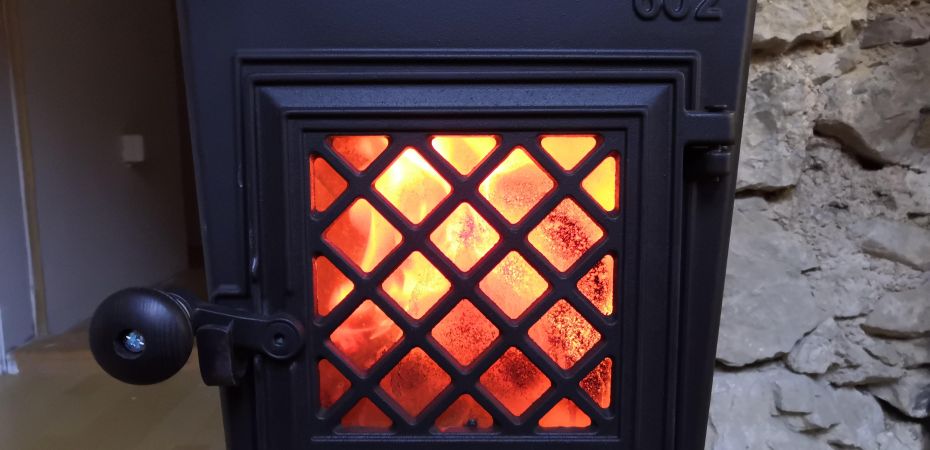
It’s been two years since I installed the Jøtul F 602 eco, long enough for a thorough assessment; here is my full review of this little Norwegian wood burner.
BTW: if you’re a fan of cosy wood burners, mountain cabins, and wild places, you may enjoy my travel-memoir Dormice & Moonshine: Falling for Slovenia – which is all about moving from England to a rugged part of Slovenia to restore a 300-year-old cabin.

Why did I buy the Jøtul F 602 eco?
I needed a stove that would fit into a very small space, to heat a small area. The Jøtul was one of just a handful of wood stoves that was the right size, shape, and energy output to tick those boxes
I also knew that Jøtul was a respected company, with a long history of making quality stoves. Indeed, I’d read that the Jøtul 602 is the world’s best-selling stove, but strangely, I could find no mention of such a claim to fame on Jøtul’s website. Nevertheless, Jøtul do state that they’ve sold over two million F 602s – so it’s clearly an extremely popular stove.

The Good
I like the look and shape of the stove. With its long body and four legs, it’s like a loyal wood-burning black Labrador. Made of thick cast iron, it really holds the heat and compared to my Italian Piazzetta e905 which has a ceramic outer, the Jøtul stays hot to the touch for much longer.
I like the little glass door which stays relatively soot-free, and the embossed detailing of the lions on the sides is an attractive touch.
The firebox is small, although one of the advantages of the F 602 over other small stoves is that it can still handle logs up to 40cm (15.7’’) long, you just need to split them quite thinly.
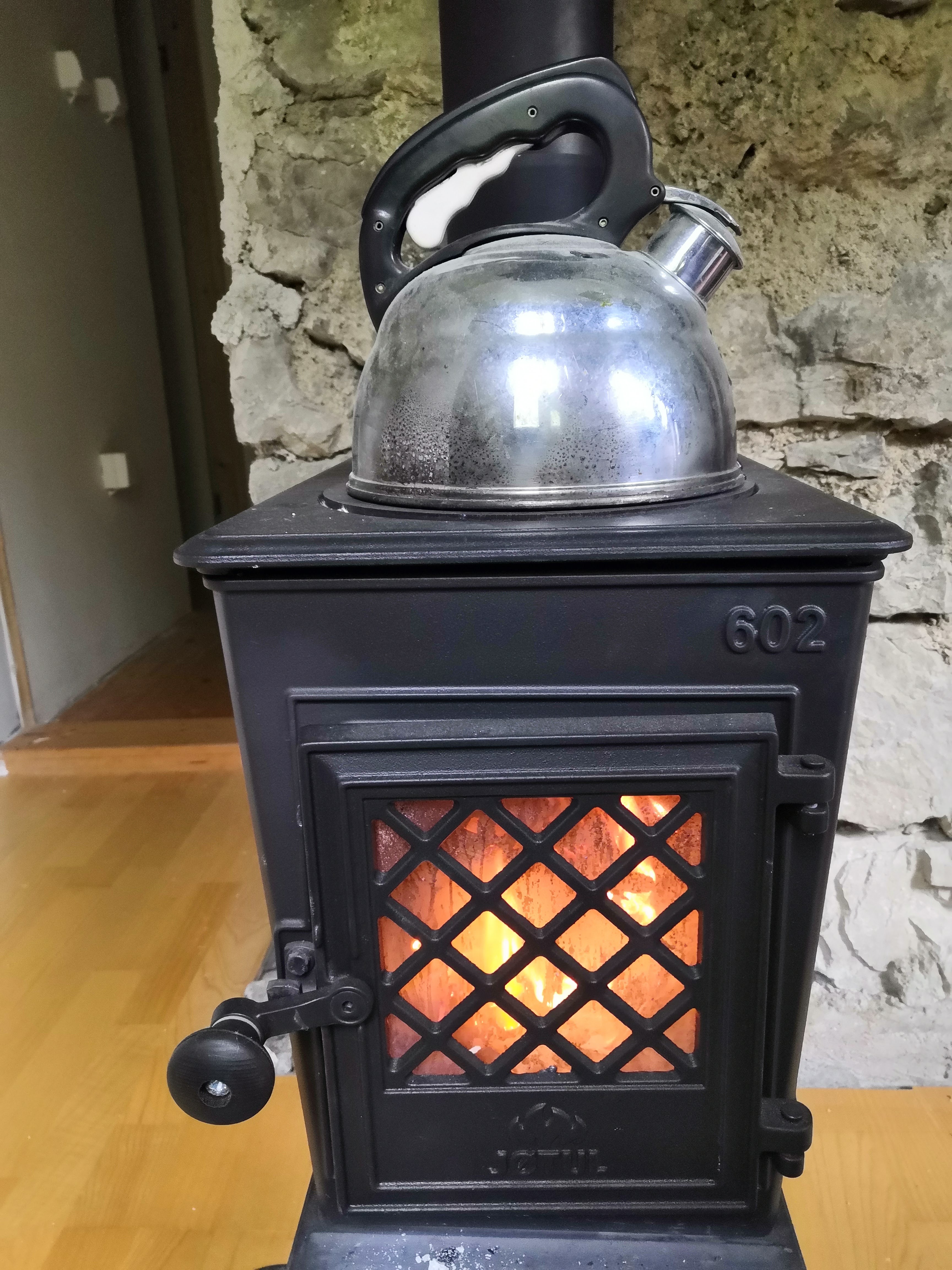
The 602 has a simple design; there is no grate, no removable ash box, and just one vent. The cooking ring on top is a handy addition; I have only required it once so far but it had my kettle whistling in no time.
Overall, the Jøtul just feels solid, has a classic aesthetic, and belts out the heat.
The Bad
My only grumble about the Jøtul F 602 is that he can be a fussy little fire. It often requires a bit more effort to get it started; I need to leave the door ajar for much longer than the Piazzetta (which I can close as soon as I light the paper) to give it sufficient oxygen to get going. If I close the door too soon, it often fizzles out.
And sometimes, when I throw a pair of larger logs in, I return thirty minutes later to find a smoldering, smoky firebox, rather than a roaring blaze, even with the air vent opened on max. Perhaps I just need to be more attentive and add smaller logs, sooner, rather than reloading with larger logs after it’s burned down to embers.
Conclusion: how good is the Norwegian wood burner?
I burn hardwood – mostly beech and oak – and I use the stove from late autumn through early spring. When it’s burning well, which is most of the time, it quickly heats up the small space – and radiates heat for hours, even when the temperature outside is down to -10c (14f).
I especially like that there are normally enough embers left overnight to just throw in some paper and kindling, crack open the door and ten minutes later – whumfff – the Jøtul is lit.
Its habit of sometimes being tricky to start, or maintain when larger logs are used, is a small downside but overall I recommend this stove for smaller rooms, or where your stove position limits you to a smaller firebox.
The build quality seems excellent, and with such a simple design but such thick cast iron construction, I think it will give me decades of hot service.

 Slovenia: Life in the SLO Lane
I agree. My new 602 (installed in 2002) was a fussy burner. I think that ash blocks the internal air inlets which are too close to the floor of the burning chamber. I solved it: I changed the door for the door of another model in the 600 range that looks similar but which has a damper in it. I was a bit nervous about doing this. The new door cost around £200 (though you might be lucky to find a second hand one on eBay for £100) and I could not be sure that the new door would fit the opening and the hinge pin sockets. But it fitted perfectly and the 602 now burns properly. I guess that Jotul left the damper off the door in order to tick an item in the Eco certification. Or perhaps they really thought that those internal air holes actually work. Those holes meant that I had to remove the ash every day – and that is a pain compared to the Jotul 8 that I had previously for 30 years and in which I let the ash accumulate for a few weeks.
Re comment above about damper in 602 door: Sorry – should have said who I am: Chris Coghill chriscoghill@gmail.com Oxford UK
Hi Chris – thanks so much for your insight. I was wondering if I had a problem with my chimney, but your explanation makes more sense. I will play with removing the ash before I light the fire next time and see if this improves the situation. Good tip for the new door too.
It actually takes logs up to 40 cm, not 33 cm.
You are correct! Thanks for pointing that out. I have updated the text.